Teachers Strike - Victoria, 2026
26 March 2026 · Adam Poulton
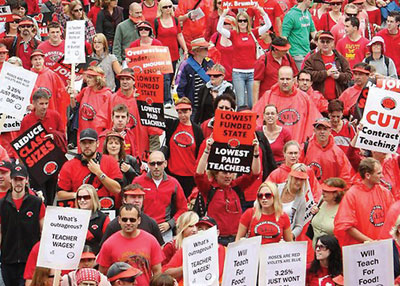
Teachers Strike - Victoria, 2026
What if this isn’t a wage dispute… but an inflation dispute?
The current teachers’ strikes in Victoria are being framed in familiar terms — pay rises, workload, budgets, negotiations.
But stepping back, it feels like something deeper is going on. There’s a real sense of strain in the system.
And it's not just teachers. The term "cost of living" is consistently trending on Google as people all over the country try to get to grips with whats going on and how they can protect their families.
At the centre of the dispute are two numbers: The government is offering 18.5% over four years (~4.3% per year) Teachers are asking for 35% over four years (~7.8% per year) On paper, the government’s position can be justified. If you look at CPI, it roughly aligns with expected inflation. But that’s where things start to diverge.
Because the lived experience for many people — and clearly for teachers — doesn’t feel like 3–4% inflation.
Housing, in particular, plays a huge role in household costs. And notably, CPI doesn’t fully capture land prices or existing housing values. So while the official measure may suggest wages are “keeping up”, people on the ground are saying something different.
This is where the conversation gets interesting. If CPI isn’t capturing the full picture, is there a better way to think about inflation? One alternative is to look at broad money supply (M3), essentially the total amount of money circulating in the economy. The thinking is that if the money supply goes up 1%, than average prices across goods, services and housing would also maybe rise by 1% and that therefore my wage should increase by 1%.
Since 2020, Australia’s M3 has grown at roughly ~7% per year. Which puts things in a different light: The government’s offer (~4.3%) sits below that level The teachers’ claim (~7.8%) sits very close to it
Framed this way, the disagreement looks less like a negotiation over pay… and more like a disagreement over what inflation actually is.
There’s another layer to this as well. The government isn’t operating in a vacuum. Budgets are tight. Costs are rising. In many ways, governments are also feeling the effects of inflation — just through a different lens. Which makes this a genuinely difficult problem.
So we end up here: A workforce that feels like it’s falling behind, A government trying to balance constrained budgets, And two very different reference points for what “fair” looks like.
Maybe the real question isn’t: “Should teachers get 18.5% or 35%?” But instead: “How should we be measuring inflation in the first place?”
Because until there’s agreement on that, it’s hard to see how these kinds of disputes get resolved in any lasting way.
Curious how others are thinking about this. Are we measuring inflation the right way? What are the longer term solutions to the 'cost of living crisis'? —
And is there a better financial way forward for all concerned?